BACK
Family Atlas - Social Directory for Large Families?
Every Eid holiday, my family ends up in the same loop.
Someone points across the room and asks, “Wait… how are we related again?” and the answer is always like this: “He’s your grandfather’s brother’s… no, his son… so technically your…”
We have a massive family tree printed and hung on the wall, and yet the simplest relational questions dissolve into confusion.
That’s the seed of Family Atlas. It’s a design experiment around one messy question:
How do you turn a huge, living family into something you can actually explore, understand, and feel close to, without making it weird or invasive?
The Real Problem Is Navigation
On paper, my family is “well documented.”
We have:
A huge printed family tree with hundreds of names.
WhatsApp groups for sub-branches.
A few scattered social media accounts and maybe a website.
Below is just a sample of the names of our 1000+ relatives.
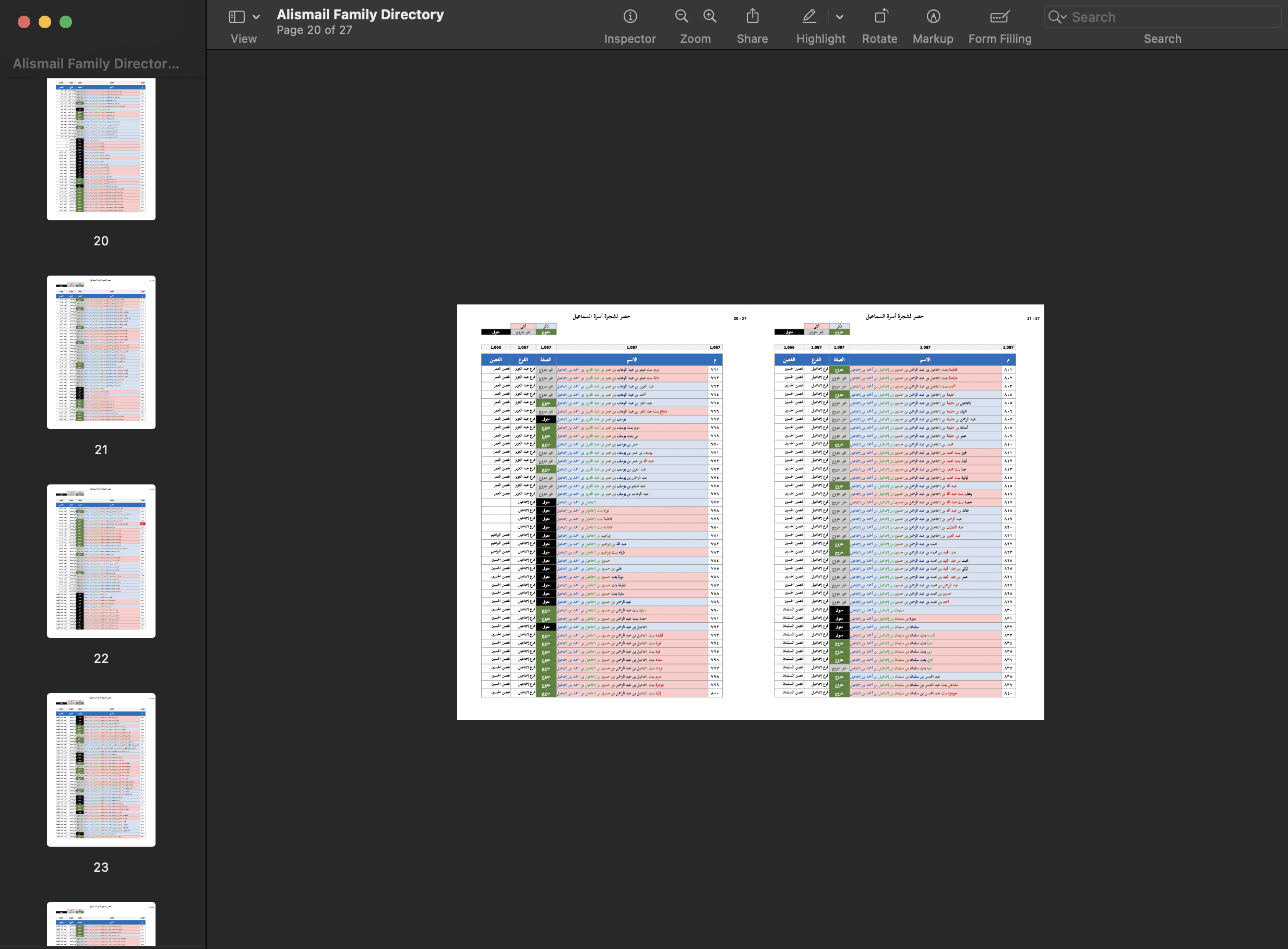
This is very common in Arab cultures: to log members, preserve records, and keep in contact with each other. I can guarantee that the Eid scenario mentioned above happens to everyone celebrating Eid!
Yet, in real gatherings, people still struggle with very human moments:
“What’s your name again?”
You recognize a face from a wedding three years ago, but you forgot their name. Asking feels awkward, especially if they clearly remember you.
“So what do you do now?”
You’d like to know who’s a doctor, engineer, designer, or student, but you don’t want to interrogate people about their job or field every time.
“How exactly are we related?”
You know someone is “from our family,” but you don’t know the exact link. Parents and grandparents can usually answer… until they can’t, or until the chain gets too long.
“Who do I contact for X?”
If you need to invite people to an event, ask about a job, or share news, you end up forwarding through multiple cousins: “Can you send this to your side of the family?”
All of this information exists, but it’s fragmented, hard to navigate, and wrapped in social friction (asking feels awkward and forgetting feels disrespectful).
So I realized:
The problem is not that we don’t have a family tree.
The problem is that family trees are created for display, not for conversation.
The Concept: A Living Map of Your Family
At a high level, Family Atlas is:
A private, interactive map of your extended family that answers “Who is this and how are we related?” in seconds, and makes it easier to connect without awkwardness.
Imagine opening the app and seeing three main spaces:
“How are we related?”
This is the heart of the app.
You select two people (yourself and someone else, or any two relatives), and the app draws the chain:
“You → your father → his brother → his son → his daughter → her husband”
Then it compresses it into something you’d actually say at a gathering:
“He’s your cousin’s husband.”
“She’s your grandfather’s sister’s granddaughter.”
Visually, you’d see a small horizontal or vertical path with faces and labels.
This is the feature that solves the “Eid problem” most directly. There’s no more standing in front of the family tree, trying to trace lines with your finger while everyone argues about where a connection broke.
Directory & Smart Filters
Sometimes the question isn’t “Who is that person?” but “Who in our family…?”
I wanted Family Atlas to answer questions like:
“Who in the family lives in Riyadh?”
“Who works in healthcare?”
“Who is around my age and in my field?”
The UI would present this as simple filters:
City
Field of work/study
Branch
Age range
This is for real-life problems, like:
Inviting the right people to a city-specific gathering.
Finding a cousin who studied what you’re about to study.
Discovering relatives in the same industry.
Existing Tools Don’t Quite Fit
There are genealogy sites, family Facebook groups, and endless WhatsApp chats. However, they all miss something specific about large extended families in places like Saudi Arabia:
Genealogy tools (like Ancestry-style platforms) are often obsessed with past generations, DNA, and distant historical records. They’re optimized for “Who were my ancestors in 1823?”, not “Who is that guy by the dessert table, and is he my cousin or my cousin’s husband?”
Social media is too wide and too noisy. There’s no clear structure, no concept of familial branches, and no way to see the actual relationship.
WhatsApp groups are the current default “infrastructure,” but they fail to answer any of the questions posed above. To give credit where its due, WhatsApp is the go-to for family announcements, which is something a feature I plan to implement, but not my main focus currently.
What I’m Designing For
As I unpacked the problem, a few design principles emerged. These are less like “features” and more the mental guardrails shaping everything else:
1. Make relationships explorable
The huge printed family tree is impressive… and useless when you’re actually standing in front of someone. Family Atlas should:
Let you start from yourself and fan outward.
Answer questions like “How is Sara related to me?” in one sentence, not 20 seconds of genealogy.
Turn giant complexity into small, navigable paths.
In other words, it’s not about showing the whole forest; it’s about giving you the exact branch from you to this person.
2. Turn awkward questions into natural interactions
The app should quietly handle things that feel socially uncomfortable to ask out loud:
Names
Occupations/fields of study
City/country
Contact details (within privacy limits)
Instead of having to say, “Sorry, what was your name again?”, you can quickly search or scan a QR near the seating area and think, “Oh, right, that’s Abdullah. He’s studying medicine in Jeddah.”
The tool doesn’t replace conversation; it just removes embarrassment.
3. Feel like a warm atlas, not a cold database
The name “Family Atlas” reflects the core feeling I want: a map, but a human one. So:
Profiles should feel like mini story cards, not corporate bios.
Branches can have their own photo, nickname, and short description.
Significant life events (graduations, weddings, births) appear as soft highlights, not noisy notifications.
For all of that, I think Family Atlas does the job.
Social & Cultural Sensitivities
Designing for families in Saudi (and similar cultures) isn’t the same as designing for a generic Western family. There are some constraints I keep in mind while designing:
Respect for elders
Older members may not want to use the app directly. So admin roles might go to younger family members who maintain info on behalf of their parents and grandparents, with their consent.
Gender and privacy norms
Some relatives may not want to display their photos, or may prefer limited visibility. The system must support:
No-photo profiles.
“Only visible to my branch” options.
Settings like “Only share my job field, not where I work.”
Informal relationships, formal structures
Real families are messy and often include step-relations, in-laws, adopted children, and “we treat him like a son” relationships. The data model must accept more than strict “bloodline” trees. Family Atlas is as much about social kinship as it is about biological relationships.
The design work here is as much policy as pixels. I tried my best to make the system’s rules should match how the family actually lives. And who knows… Maybe someday all families in Saudi will adopt this tool.