BACK
Jan 11, 2025
Reflecting on my Experience at Orlando’s Universal Studios
It's August, and I'm with my older brother at Universal Studios in sunny Orlando, Florida. Universal Studios is known as one of the world's top adventure parks, but I noticed a common theme among such places. It's those never-ending lines where it's not unusual for visitors to spend most of their day waiting in line just for a 3-minute thrill ride. Can you believe that? So, I started wondering, why don't theme parks let you book your rides in advance? It'd save a ton of time, right?
Well, it turns out there's a simple answer to that. Long lines mean more money. People stuck waiting are more likely to splurge on extra days at the park or buy those fancy "speedy passes" to skip the queues. So, theme parks clearly prioritize their profits, which is disappointing from a customer's point of view. Especially when you map out the whole journey, you'll notice that our satisfaction is swinging up and down, where "up" is when it's our turn to play the game and "down" when I'm waiting for it. Is there any way we can redesign the park so it's more "up" and less "down", but at the same time secure profit? This seems like too much to ask for, but imagine what would happen if it were true.
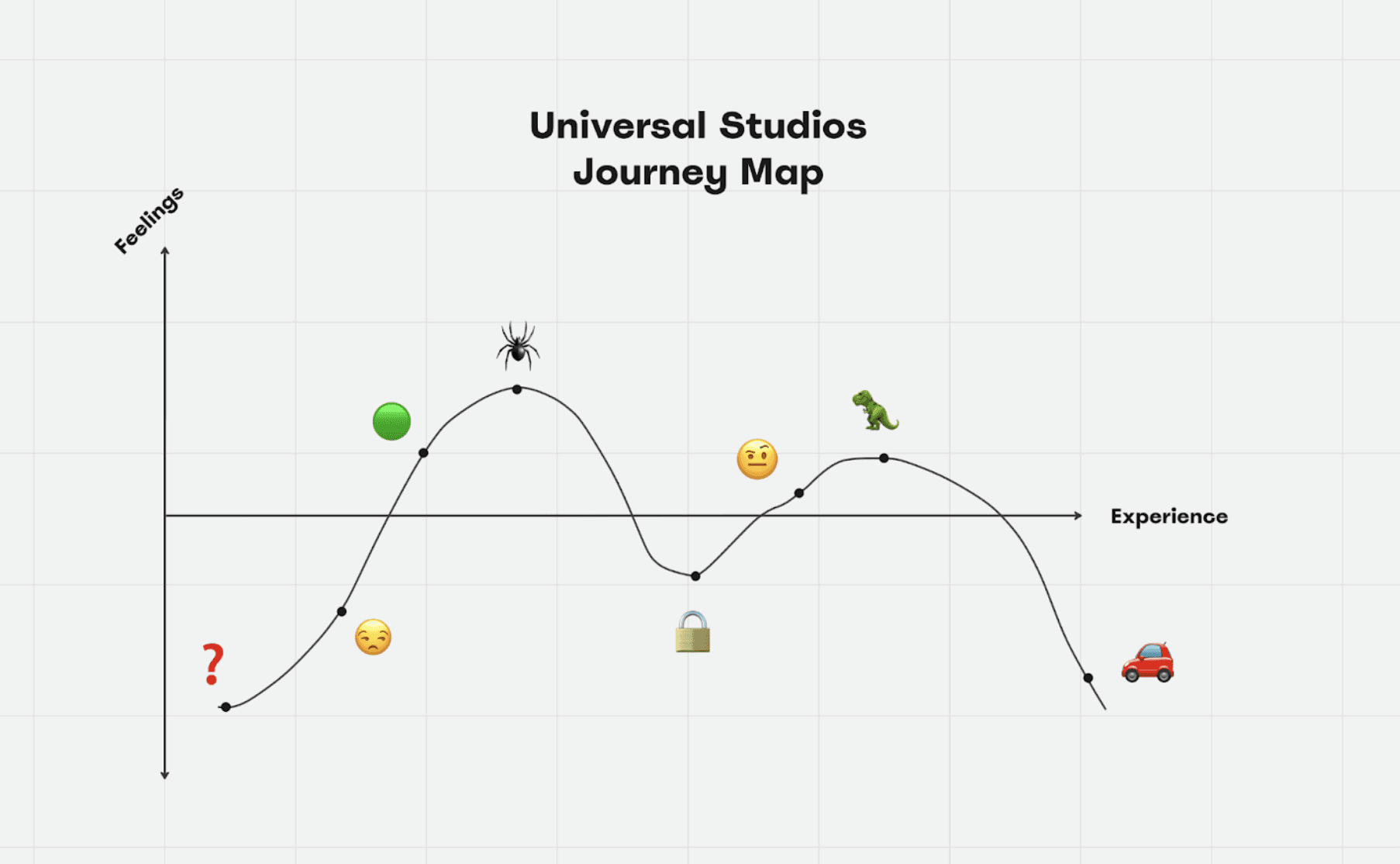
Unironically, our experience at Universal Studios looks like a rollercoaster itself. We began our journey with confusion, not knowing where to park or where to enter. Once inside, we eagerly made our way to a highly recommended ride called "The Incredible Hulk Coaster," but the long line and seeing people with an "Express" ticket skip our turn and pass right in front of us made our excitement turn into frustration. After a 45-minute wait, the coaster certainly delivered the thrill we hoped for (Figure 1). Next was The Spiderman ride, which had a unique waiting area designed to resemble The Daily Bugle's office (a newspaper company that's part of Spiderman's story). We also watched a Spiderman cartoon episode that was playing in the background. Not to mention that the ride itself did not disappoint, so our experience there reached its peak enjoyment, as can be seen in our journey map. However, our excitement died off as we discovered that the highest-rated ride, Hagrid's Adventure, was temporarily closed. On a positive note, we concluded our day with the outstanding Jurassic Park ride, which we enjoyed even though we struggled to find the entrance. The post-ride store was also impressive since it has a mini-museum with a few interactive games. I wish we could enjoy these little activities while we wait in line instead of after the game finishes. As we were getting ready to leave, rain started pouring, and we spent thirty minutes not knowing where we parked our car, which explains how our last impression was a low point. If Universal Studios were to fix those low points in the graph, aka "pain points," I believe they would create unforgettable experiences.
For our car, we had the chance to rent a Tesla Model 3. Let me tell you, this vehicle is a whole new experience. When I hopped inside, I was amazed to find only two physical buttons: one to open the window and one to open the door. That's it? Well, everything else is on a massive touchscreen between the driver and the passenger seat.
This super-simple design got me thinking. Some people might prefer that pilot feeling where they have multiple buttons and controls all around the car, while others are more comfortable with a minimalist approach; how can Tesla design something that satisfies both? It's a bit like the story of Apple's iPhone: remember Steve Jobs ditching all those physical buttons in favor of a single "Home" button and a giant touchscreen? Yeah, that kind of simplicity. From Jobs' perspective, if you want your product to be used by as many people as possible, you must make it easy to learn and use. So, reflecting on Tesla's design, simplicity is the way to go.
Believe it or not, Tesla uses a problem-solving methodology called Design Thinking, a series of steps to generate solutions: Empathize, Define, Ideate, Prototype, and Test. Of course, design thinking is not the sole way to come up with solutions, so I would disagree with Ms. Netasha Jen on how this process is bullsh*t since it's a mere template and may or may not be followed to the tee. For Tesla, the problem statement they had in the “Define” stage, wasn’t like other car companies because their problem didn’t only tackle transportation but also environmental impact. It’s amazing how Toyota and Tesla both use design thinking, yet their final designs are far apart, which really shows how one methodology can lead to different products.
In Orlando, we stayed at an Airbnb instead of a traditional hotel. This decision turned out to be a game-changer. Airbnb excels at customer satisfaction because they really value "design research." You see, Airbnb knows that every traveler is different, with their own unique preferences and needs. Before booking, guests can communicate directly with hosts, getting a sense of the property and the host's personality. It's like having a friend at your destination, guiding you to the best local spots. After your stay, you would have the chance to give feedback to the host and impressions on using the Airbnb platform. So, one thing Airbnb applies very well is constantly communicating with the end-users about their experience. Like Thomas Edison once said, "There's a way to do it better - find it." And design research can get us closer to this so-called “better way.”
One thing to mention about doing research is sometimes surveying customers is not enough. For example, when IDEO was redesigning Air New Zealand's flight experience, they said: "You ask passengers such questions as where they put their feet when they sleep, and they can't really tell you. But when you watch the contortionist positions they put themselves in, you learn a lot." So, observing customers’ behavior is another effective research methodology that can be more accurate than feedback. An even better way to conduct research is to actually put yourself in their shoes, like how an IDEO team member flew economy class worldwide in five different airlines to truly understand the passenger's perspective.
Fast forward a bit, we ended up having dinner at the world's biggest restaurant chain, McDonald's. I admire McDonald's because of how they redesigned the food buying experience by employing the concepts of "Systems Thinking." In brief, it's a problem-solving approach that investigates all the factors that play a part in the final outcome. Since McDonald's values speedy food preparation, they ensure that all the interconnected factors contributing to their service are done in the most efficient way possible – from the supplier to the cook to the cashier. It's not easy, considering the amount of interactions you’d have to account for.
Looking back at my trip to Orlando, I finally understand how the concepts we learned in class, like journey mapping, design thinking, design research, and systems thinking, are applied in our everyday lives. And I soon realized that almost everything around us is an experience that was designed by other people who are no smarter than us, as Steve Jobs once said.
More